
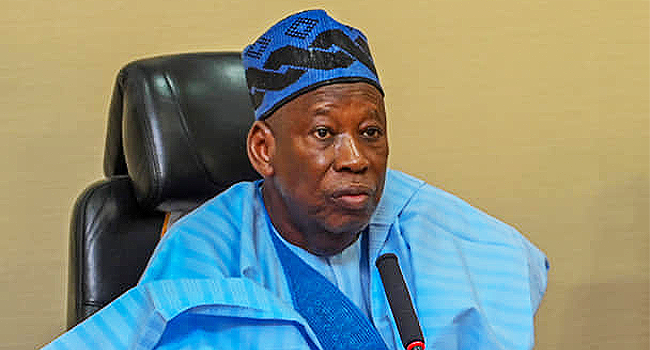
Abdullahi Ganduje has resigned as the National Chairman of the All Progressives Congress (APC), citing health grounds. However, sources suggest that his resignation was triggered by President Bola Tinubu’s alleged plan to bring former Kano State Governor Rabiu Kwankwaso into the party. The two have a long-standing feud, dating back to when Ganduje succeeded Kwankwaso as governor in 2015.
Key Details:
– Ganduje’s Resignation: Effective immediately, with Ali Bukar Dalori set to assume the position of Acting National Chairman
– Reason for Resignation: Officially cited as health concerns, but reportedly due to Kwankwaso’s potential defection to APC
– Ganduje-Kwankwaso Feud: The two former governors have clashed over control of Kano’s political structure and influence
– Party Reaction: APC has confirmed Ganduje’s resignation and assured party members and Nigerians of its commitment to delivering on the “Renewed Hope Agenda”
Reactions:
– Buba Galadima, a close ally of Kwankwaso, denied knowledge of Kwankwaso’s defection plan but mentioned a meeting to “sacrifice Ganduje and Vice President Kashim Shettima” to bring new leadership
– Ganduje’s aide, Salihu Yakasai, expressed disappointment on social media, questioning Tinubu’s decision
– Bashir Ahmad, former media aide to ex-President Muhammadu Buhari, confirmed Ganduje’s resignation on Facebook
APC National Publicity Secretary, Felix Morka, disclosed that “In his letter of resignation addressed to the National Working Committee (NWC) through the National Secretary, Ajibola Basiru, Ganduje expressed gratitude to the President and Commander-in-Chief of the Armed Forces, Bola Tinubu, for the opportunity to serve the party at the highest level.”
Sources within the APC national secretariat reported that tension had been mounting since Friday afternoon, with Ganduje threatening to resign as early as “3 p.m.” following reports of the Tinubu-Kwankwaso deal.
Efforts to convince him to stay reportedly involved key party figures, including National Secretary Ajibola Basiru.
A party source revealed, “We are currently pleading with him (Ganduje) not to resign. He is upset that Kwankwaso is coming to the APC. I think the two of them are sworn enemies. All the stakeholders are begging him to stay.”
Despite these efforts, confirmation of Ganduje’s resignation came shortly after “4:15 p.m.”
Another insider added, “He has eventually resigned. We couldn’t stop him. I think there is something personal between him and Kwankwaso, who is ready to join the APC after some discussions with the President.”
When asked about the atmosphere at the APC secretariat, a staff member said, “There is no crisis, just that the chairman has resigned and people gathered at the secretariat to discuss about it.”
The longstanding feud between Ganduje and Kwankwaso dates back to their years in Kano politics. Both were once allies under the Peoples Democratic Party (PDP), with Kwankwaso serving as governor from “1999 to 2003” and again from “2011 to 2015,” while Ganduje was his deputy during the latter tenure.
Their political alliance fractured after Ganduje succeeded Kwankwaso as governor in “2015” under the APC, igniting years of rivalry over Kano’s political dominance.
A major flashpoint in their feud was the “2020 dethronement of Emir Muhammadu Sanusi,” a known Kwankwaso ally. Sanusi was later reinstated as Emir on “May 23, 2024,” by Governor Abba Yusuf of the New Nigeria Peoples Party (NNPP), under Kwankwaso’s political leadership.
Although Ganduje officially cited “health concerns” as his reason for stepping down, political analysts believe his resignation is directly tied to the recent political reconciliation between Tinubu and Kwankwaso.
When asked about Kwankwaso’s rumoured defection, a close ally, Buba Galadima, responded, “I am not aware of the defection plan.
However, I know Kwankwaso and Ganduje have personal issues. I am equally aware that there was a meeting of APC stakeholders and the presidency three days ago where they agreed that Ganduje and Shettima should be sacrificed to bring a new set of people into government and the party.”
President Tinubu, who was elected in “2023,” is believed to be repositioning the APC ahead of the “2027 general elections.”
Meanwhile, the opposition is mobilising for a coalition aimed at unseating the ruling party, with key figures like “2023 presidential runner-up Atiku Abubakar and Labour Party candidate Peter Obi” leading the charge.